


Draft Law No. 8800 on the 2027 budget (the “Draft Budget Law”) and a draft grand-ducal regulation (the “Draft GDR”) propose to raise, subject to conditions, the rate of accelerated depreciation for residential rental property to 6%, with effect from tax year 2026. The new rate would apply in particular to buildings acquired or built from 1 January 2026, completed less than six years earlier and whose depreciable value at completion does not exceed EUR 600,000.
In brief
Since 2021, accelerated depreciation at 4% has been available, subject to conditions, for residential rental property completed less than five years earlier. For buildings recorded as business assets, it is provided for by Article 32ter of the Luxembourg Income Tax Law (“LITL”). It then covers both individual entrepreneurs (commercial, agricultural and forestry or professional income) and companies and other collective entities subject to corporate income tax (“CIT”). For residential property held as private assets by individuals, it is provided for by Article 106(4) LITL and its implementing grand-ducal regulation (the “GDR”), which since 2023 has limited the 4% rate to two buildings, the others being depreciated at 2%, subject to transitional provisions. A special real estate allowance of 1%, capped at EUR 10,000, is added under Article 129e LITL where the 4% accelerated depreciation applies.
The Draft Budget Law and the Draft GDR would raise this rate to 6%. According to the explanatory memorandum, the aim is to “improve the profitability of rental investment, while preventing rising prices from automatically generating higher tax benefits” (free translation). Hence a cap: the 6% rate would be reserved for dwellings whose depreciable value at completion does not exceed EUR 600,000. The new rate would not be limited in terms of the number of dwellings. Above the cap, the 4% rate would remain available for acquisitions made in 2026, but would no longer be available for those made from 2027. The previous regimes are maintained by transitional provisions, subject to their own conditions.
The EUR 600,000 cap
The cap would be assessed according to rules common to both texts:
Value at completion: for a building, this is the value forming the basis for calculating depreciation at the date of completion, i.e. excluding land. It remains the reference in the event of a subsequent purchase, whatever the price paid, and the purchaser would apply the 6% rate to their own depreciation base.
Property considered as a whole: where the same property is held in joint ownership, its value is not split according to the respective shares when assessing eligibility for the new regime.
Threshold effect: if the value exceeds EUR 600,000, the 6% rate would be excluded in full, and not only on the portion above the cap. The dwelling would then fall under the other applicable rates described below.
Renovations: the cap does not apply to the amount of the works, but to the acquisition price of the building considered as a whole if it was purchased, or to its cost price if it was built by the owner, as determined at the time of acquisition or construction. For the purposes of the cap, the cost of the works is not added to this price.
The age of the building is assessed at the start of the financial year for business assets, and on 1 January of the tax year for private assets. For business assets, accelerated depreciation remains excluded where the building’s components are depreciated separately.
Acquisition or construction of a rental dwelling from 2026
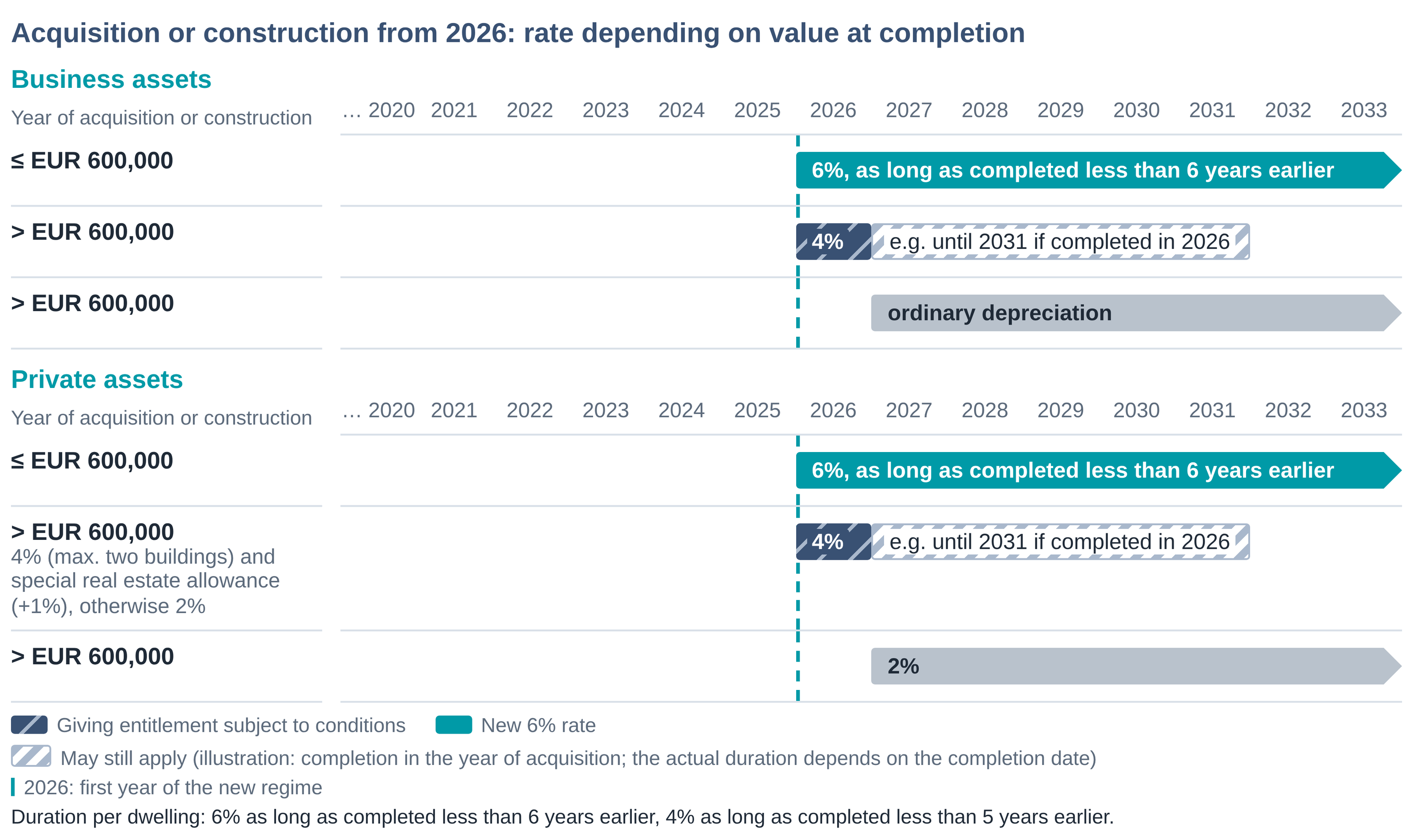
Where the depreciable value at completion does not exceed the cap, the 6% rate would apply to both business and private assets, in each year in which the dwelling was completed less than six years earlier. Eligibility depends on the age of the dwelling, not on the time elapsed since its acquisition.
Above the cap, a dwelling acquired or built in 2026 could still be depreciated at 4% as a business asset if the conditions for that rate are met, in particular completion less than five years earlier. As a private asset, it would qualify for the 4% rate, together with the 1% special real estate allowance, under the same conditions and within the limit of two buildings, and otherwise for the 2% rate.
For acquisitions or constructions made from 1 January 2027, the 4% rate would no longer be available: above the cap, only ordinary depreciation over the normal useful life would remain for business assets, and the 2% rate for private assets.
The 6% rate would not give entitlement to the special real estate allowance. For private assets, however, a dwelling acquired in 2026 at the 6% rate could count towards the limit of two buildings eligible for the 4% rate.
Rental dwelling acquired before 2026
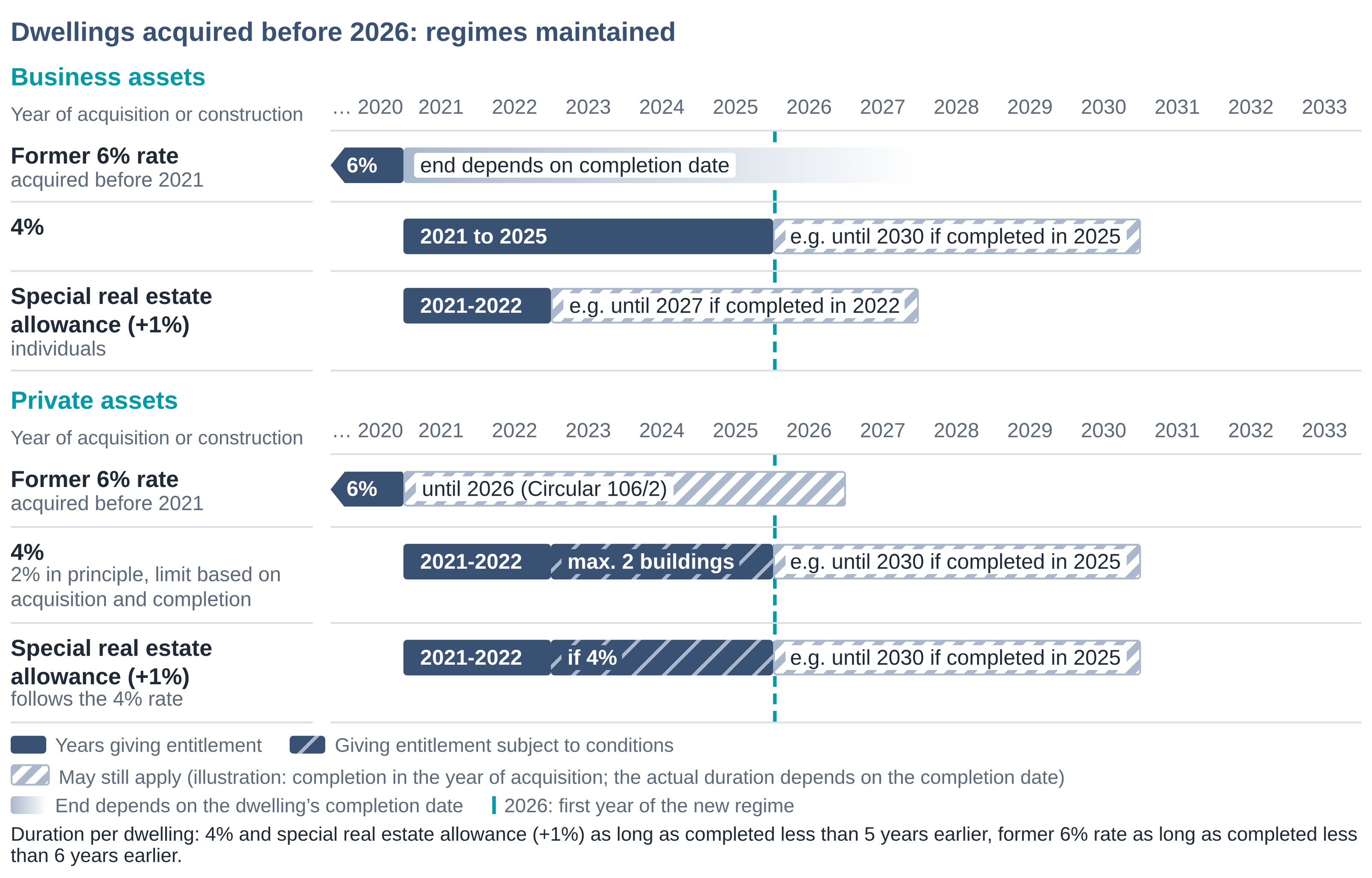
The previous regimes continue to apply under transitional provisions, subject to their own conditions. These conditions depend on both the date of acquisition and the date of completion.
The 4% rate would continue to apply to dwellings acquired or built from 2021 to 2025, as long as they were completed less than five years earlier (at the start of the financial year for business assets).
For private assets, since 2023 this rate has been limited to two buildings per taxpayer over the entire period of tax liability, subject to the specific rules on joint taxation. Other dwellings are depreciated at 2%.
For business assets, a literal reading of the proposed text would then allow the new 6% rate to be applied to these dwellings once they were completed at least five but less than six years earlier at the start of the financial year, subject in particular to the EUR 600,000 cap. The commentary on the draft does not address this situation, which could be clarified during the legislative process.
Dwellings acquired before 2021 retain the former 6% rate as long as they were completed less than six years earlier.
The special real estate allowance (Article 129e LITL) is added to the 4% rate for individuals: 1% of the bases depreciated at 4%, up to EUR 10,000 per year and per taxpayer, granted automatically. It does not apply to the 4% rate applied to renovation expenditure. For business assets, this allowance only covers dwellings acquired or built in 2021 or 2022 and is not available to companies subject to CIT.
Rental dwelling acquired off-plan (VEFA) in 2024 or 2025 (private assets)
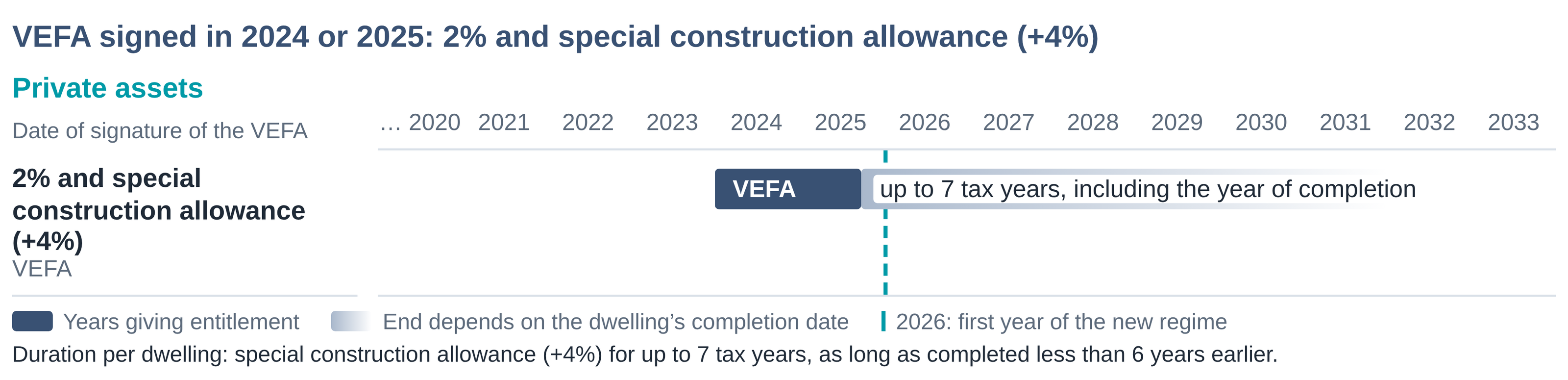
Dwellings acquired by notarial deed of off-plan sale (vente en état futur d’achèvement, “VEFA”) signed between 1 January 2024 and 30 September 2025 (subject to conditions for the last quarter) would remain outside the new 6% rate. They would continue to be depreciated at 2% and would retain the special construction allowance (Article 129f LITL): 4% of the bases depreciated at 2%, subject to an annual cap of EUR 250,000 per taxpayer, for up to 7 tax years, including the year of completion, as long as the dwelling was completed less than six years earlier. These dwellings do not count towards the two-building limit, and the allowance cannot be combined with the Article 129e allowance for the same building.
Renovation of an existing dwelling
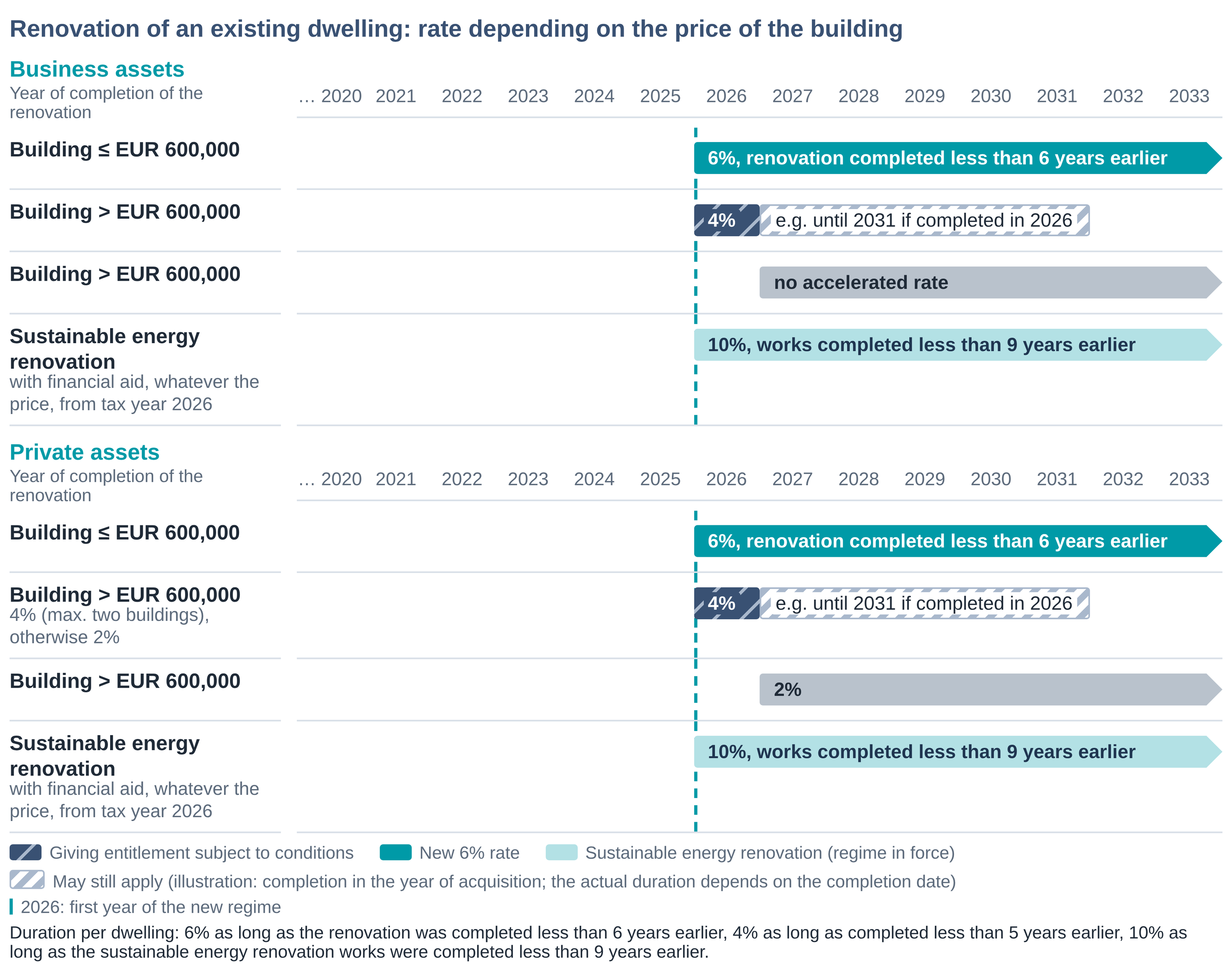
Ordinary renovation. Capital expenditure on a renovation completed from 2026 would qualify for the 6% rate if it exceeds 20% of the price of the building (excluding maintenance and repair costs), if that price does not exceed EUR 600,000 and as long as the renovation was completed less than six years earlier. Above the cap, a renovation completed in 2026 could still qualify for the 4% rate if its conditions are met, for both business and private assets. For private assets, however, this rate remains limited to two buildings, the 2% rate applying otherwise.
Where the price of the building exceeds EUR 600,000, an ordinary renovation completed from 2027 would no longer qualify for any accelerated rate: ordinary depreciation would apply for business assets, and the 2% rate for private assets, without prejudice to the separate regime for sustainable energy renovation.
The 6% rate would remain available for renovations where the price of the building does not exceed the cap, subject to the other conditions of the regime.
Sustainable energy renovation: a separate 10% regime. This regime, already in force, provides for a 10% rate from tax year 2026, compared with 6% previously, for both business and private assets. Financial aid within the meaning of Article 4 of the amended law of 23 December 2016 must have been granted, and the works must have been completed less than 9 years before 1 January of the tax year.
Conclusion
The Draft Budget Law and the Draft GDR provide for the new regime to apply from tax year 2026, with no end date. These drafts must still be adopted before entering into force.
In practice, investors in residential rental property will now need to know the depreciable value at completion in order to assess eligibility for the new regime. Up to and including EUR 600,000, a dwelling acquired or built from 2026 would be depreciated at 6% as long as it was completed less than six years earlier, compared with 4% until now. The new regime would not include any limit on the number of dwellings. 2026 would also be the last year of acquisition giving entitlement to the 4% rate. As the special real estate allowance is reserved for dwellings depreciated at that rate, it would no longer be available for acquisitions made from 2027. For dwellings already held, the previous regimes are maintained by transitional provisions, subject to their own conditions, and these benefits will expire as each property ages.
Share on

