

Seven filing mistakes are adding weeks to Luxembourg fund launches. Here is how to avoid them.
Most delays in Luxembourg fund authorisations are within the applicant's control, not the regulator’s.
On 3 August 2026, the CSSF published updated statistics, current as of 30 June 2026, on how long it takes to authorise a new regulated investment vehicle in Luxembourg. The figures confirm that processing time splits into two distinct components:
- the CSSF's own assessment period and
- the time taken by the applicant to respond.
A meaningful share of any delay sits on the applicant's side of that split.
While the CSSF frames its review of each application as an in-depth, public-interest exercise, not an administrative formality it is cognisant of the fact that the market requires some predictability on the time for authorisation. In this light the CSSF confirmed that it is investing in digital tools and standardised submissions to make timelines more predictable.
What is in scope
The statistics cover initial authorisations completed since 1 January 2020 for UCITS, specialised investment funds (SIFs) and undertakings for collective investment (UCIs) subject to Part II of the Luxembourg law of 17 December 2010 relating to undertakings for collective investment. Investment companies in risk capital (SICARs), governed by the Luxembourg law of 15 June 2004 relating to the investment company in risk capital, are excluded from the scope, along with statistical outliers such as withdrawn applications.
Processing time runs from the CSSF's receipt of the application to its authorisation or refusal decision and is measured in working days. It is not the same as time to market, which also includes pre-filing preparation and post-authorisation steps.
The seven mistakes that slow a filing down
The CSSF's published guidance identifies a consistent set of avoidable errors on the applicant side:
Filing before the project is finished
Incomplete forms or supporting documents, fragmented files returned for correction, and scope changes requiring a fresh filing are named as concrete causes of delay. File once, completely.
Under-explaining a complex structure
For complex projects, the CSSF recommends an explanatory memo proactively covering structure, investment policy, strategy, instruments and legal and regulatory compliance, together with careful prospectus (and KIID, where applicable) drafting.
Slow or partial replies to CSSF queries
The CSSF bundles its clarification requests and expects an exhaustive, consolidated response to maintain momentum in the review.
Sending unmarked revisions
Amended drafts sent during examination should be marked up, with mapping sheets where required.
Introducing new features mid-review
Substantial changes or new features introduced during examination are treated as a new project requiring a new application.
Delaying submission of final documents after approval
Once the CSSF notifies the end of the examination phase, it expects timely delivery of the final e-identified prospectus and the signed final documents requested in the end-of-examination letter. Up to one month after that letter is considered reasonable, and two months is the maximum, after which the CSSF can treat the application as abandoned.
Changing the prospectus after CSSF validation
The final prospectus submitted for e-identification must be strictly identical to the CSSF-validated version; any unapproved change is prohibited and invalidates the authorisation granted.
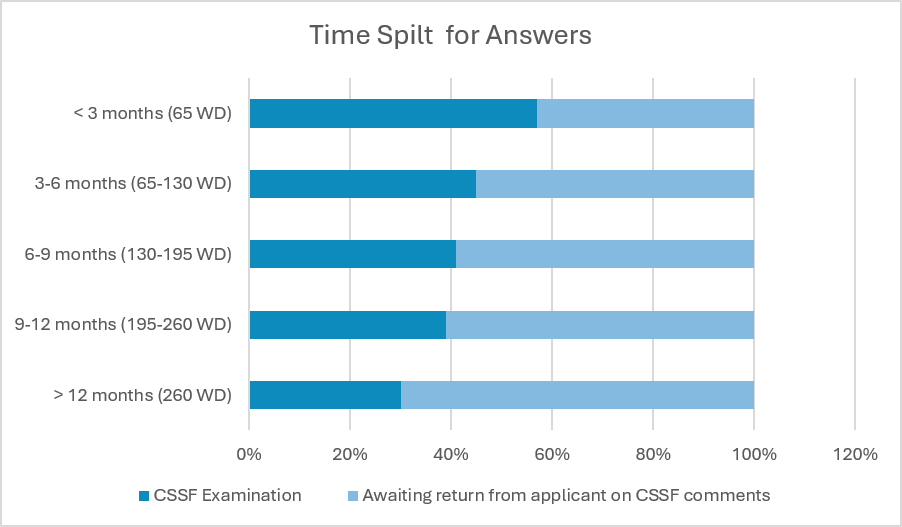
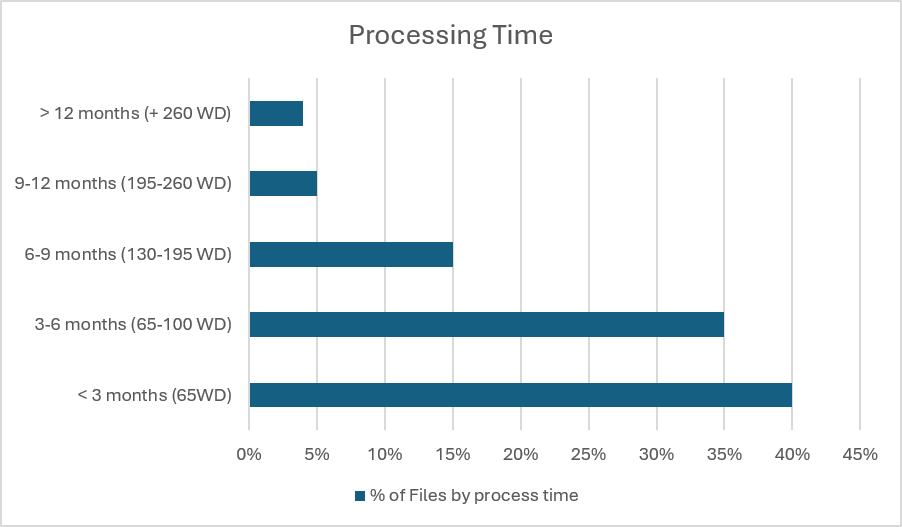
Source: CSSF, "Processing time of initial authorisations of regulated investment vehicles", published 3 August 2026.
What this means for you
For promoters and managers, the practical consequence is that the fastest route to authorisation is not pushing the regulator, it is controlling everything on your own side of the process:
submit a complete file at filing,
explain complexity proactively,
respond to queries fully and quickly,
mark up revisions clearly,
avoid scope creep once examination has started, and
deliver unchanged closing documents promptly after the end-of-examination letter.
Share on

