

On 7 July 2026, ESMA published a supervisory briefing on “Triangular Passporting” under Directive 2014/65/EU on markets in financial instruments ("MiFID II”, the “Briefing”). Asset managers with MiFID permissions should review their cross-border structures now - ESMA expects full alignment with passporting rules. The Briefing aims to harmonise the supervisory practices of national competent authorities (“NCAs”) when dealing with so-called "triangular" passporting arrangements.
Scope
The Briefing is addressed to "firms" - referring to investment firms, including credit institutions, providing investment services or performing investment activities - and covers "investment services" as investment services and/or investment activities as well as ancillary services. Strictly speaking, it does not address investment funds, their management companies (UCITS/AIFs), or the cross-border distribution of fund units or shares, which are governed by separate regimes (the UCITS Directive, the AIFMD and the Regulation on the Cross-Border Distribution of Funds). However, the Briefing does have an impact on the fund industry, as many asset management groups house MiFID activities (portfolio management on behalf of third parties, investment advice and the reception and transmission of orders) within dedicated MiFID entities or within management companies holding additional authorisations.
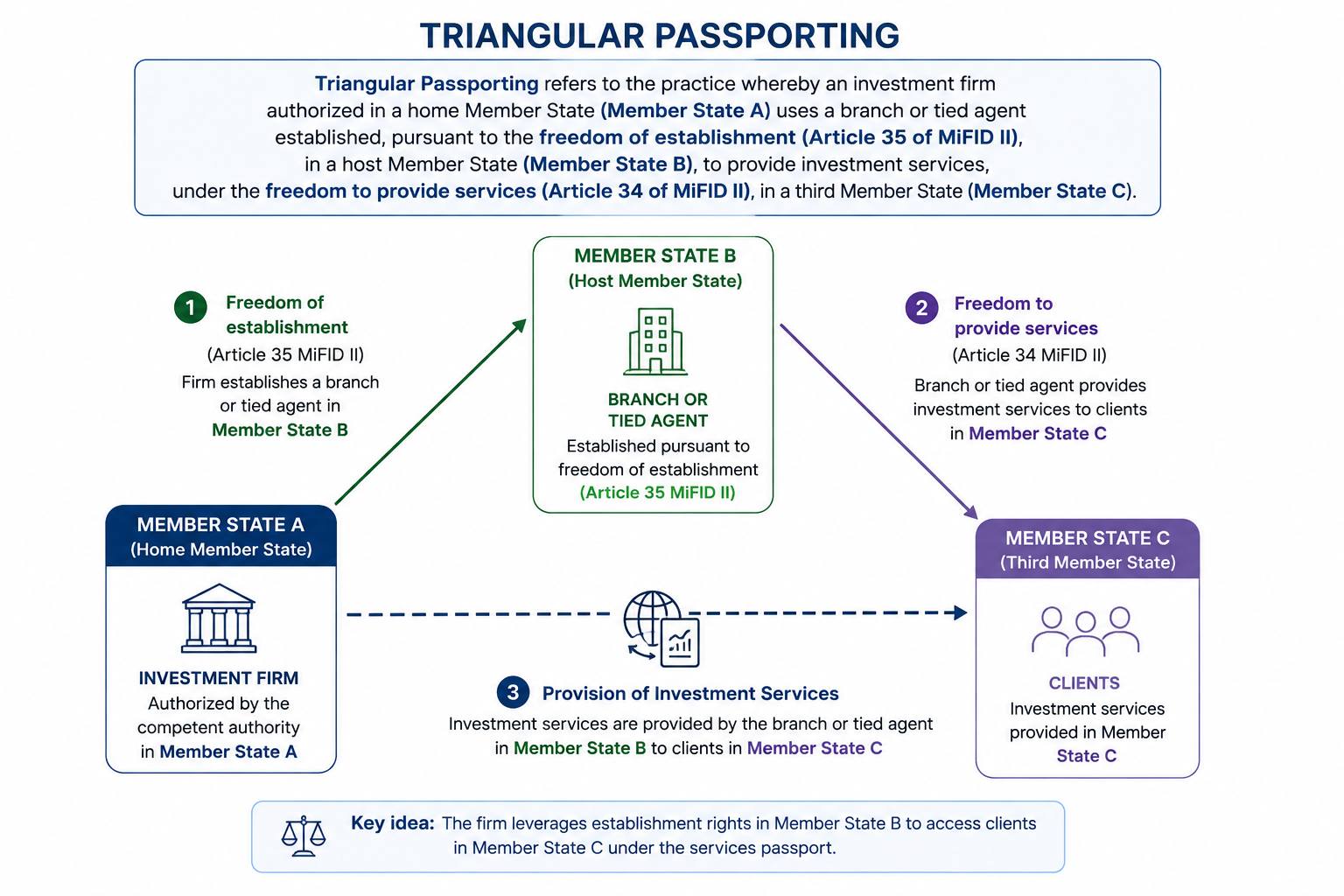
What is “Triangular Passporting”?
The benefits of the briefing for fund managers
The Briefing is particularly relevant where an AIFM or UCITS management company also has MiFID permissions for services such as portfolio management, investment advice or other additional services.
For these managers, ESMA highlights several requirements.
Passport notification
The triangular arrangement should be expressly identified in the notification to the home NCA.
Consistency between notified and actual activities
ESMA expects the branch or tied agent to be fully operational in Member State B before providing cross-border services from B to C, with those services remaining within the scope of the firm's passporting notifications under both Articles 34 and 35 of MiFID II.
Substance
Firms should not use Triangular Passporting to circumvent supervisory competences or engage in "forum shopping"; establishing a branch or tied agent in Member State B solely to passport services to Member State C could be considered not in line with Article 35 of MiFID II.
Risk assessment
ESMA expects firms relying on Triangular Passporting to conduct and regularly review an internal risk assessment covering, for example, investor protection, anti-money laundering and terrorist financing, outsourcing responsibilities, and third-party risks.
Tied agents
The agreement between the firm and a tied agent is expected to explicitly authorise the tied agent to provide cross-border services on behalf of the firm. Indeed, Article 29(2) of MiFID II stipulates that where a firm "decides to appoint a tied agent it remains fully and unconditionally responsible for any action or omission on the part of the tied agent when acting on behalf of the investment firm."
It is worth noting that Member States may also adopt more stringent provisions than those laid down in MiFID II regarding tied agents, under Article 29(6) MiFID II.
Client information
Clients in Member State C must be informed that services are provided through the branch/tied agent in Member State B and that the home-state NCA remains the competent authority. Article 75(1) of MiFID II requires Member States to ensure that firms adhere to one or more extra-judicial mechanisms for consumer complaints, and firms are expected to inform clients about complaints/redress procedures and applicable investor compensation schemes. Finally, firms are also expected to include such cross-border complaints in their complaints-handling procedure established under Article 26 of the MiFID II Delegated Regulation.
Supervision
The home NCA retains primary responsibility for organisational and conduct-of-business requirements relating to the firm's services abroad, while the NCA in Member State B is responsible only for the branch's/tied agent's conduct of business when providing services within Member State B. Under Article 86 of MiFID II, where investor interests or the orderly functioning of markets in the host Member State are at risk, the host NCA may take precautionary measures if those taken by the home NCA are insufficient or inadequate. NCAs are also required to cooperate with each other for the purposes of carrying out their duties under MiFID II, per Article 79(1) MiFID II.
Broader relevance for the fund industry
Although the Briefing does not create a triangular passport regime for funds, its principles may be relevant by analogy to cross-border fund activities. It reflects a wider EU trend towards greater supervisory convergence, transparency and clearer allocation of responsibility between NCAs. This is also consistent with the European Commission's proposed “Market Integration and Supervision” package, which seeks to simplify cross-border passporting and marketing regimes for UCITS and AIFs.
Key considerations and practical recommendations
For asset management groups with MiFID activities conducted through branches or tied agents in several Member States, ESMA recommends:
Mapping existing structures to identify triangular arrangements.
Checking that actual activities correspond to passport notifications;
Reviewing tied-agent agreements to ensure cross-border activities are expressly authorised.
Updating client disclosures and complaints procedures to reflect the relevant service provider and competent authority.
Share on

