



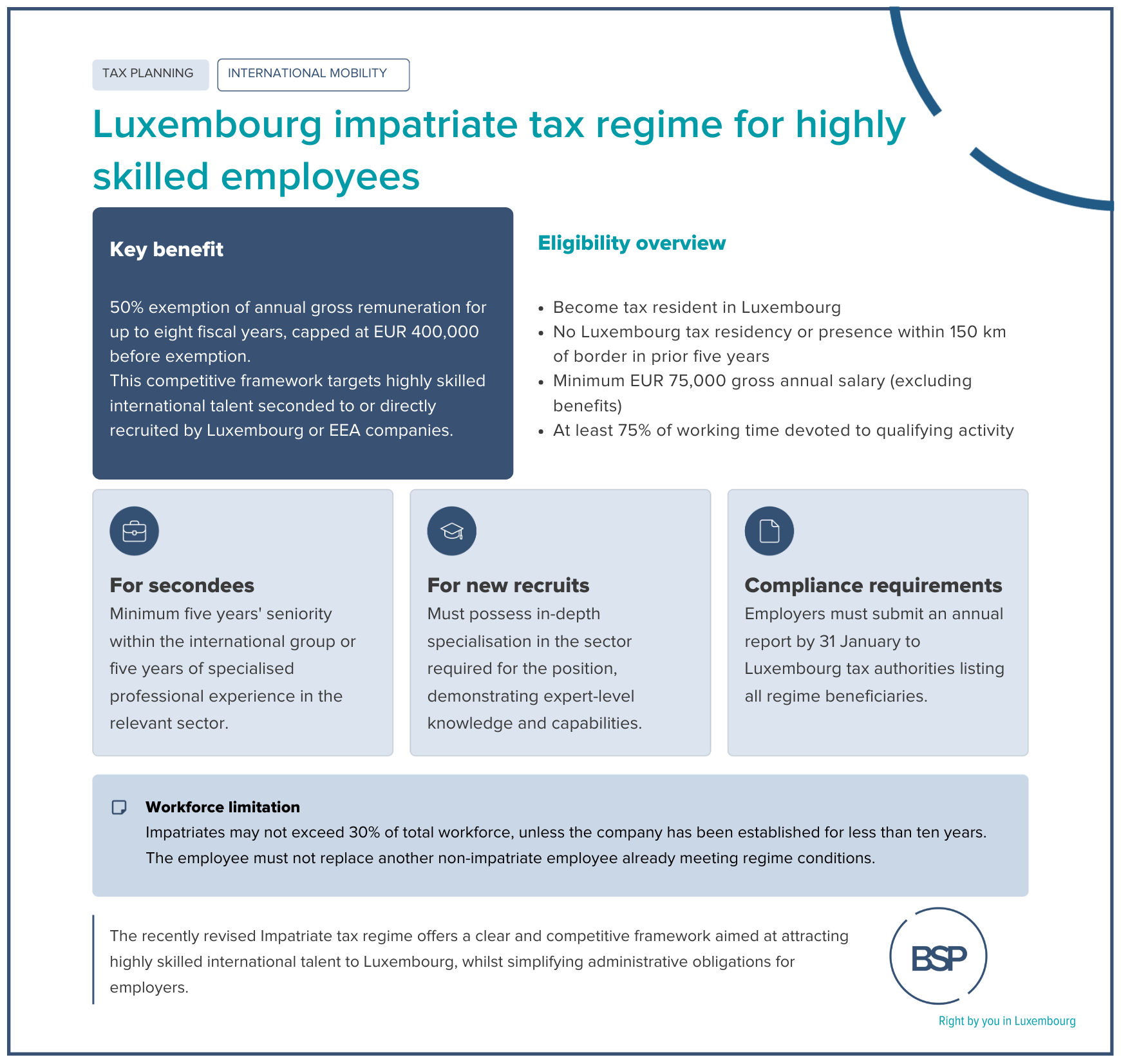
Luxembourg offers an attractive tax regime for impatriate employees who are either seconded to a Luxembourg company within an international group or directly recruited from abroad by a Luxembourg or EEA company.
The regime provides for a 50% exemption of annual gross remuneration, capped at EUR 400,000 (before exemption), for a period of eight fiscal years.
Key requirements
- The employee must become tax resident in Luxembourg.
- The employee must not have been tax resident in Luxembourg, must not have lived within 150 km of the Luxembourg border, and must not have been subject to Luxembourg personal income tax during the five years preceding the start of employment in Luxembourg.
- At least 75% of the working time must be devoted to the activity for which the exemption is granted.
- A minimum fixed annual salary of EUR 75,000 gross (excluding cash and in-kind benefits) is required.
- The employee must not replace another non-impatriate employee who already meets the conditions of the regime.
Definition of a highly skilled employee
- For secondees: the individual must have at least five years of seniority within the international group or five years of specialised professional experience in the relevant sector; or
- For new recruits: the individual must possess an in-depth specialisation in the sector required for the position.
Limitations and reporting obligations
- The number of impatriates may not exceed 30% of the total workforce of the employer, unless the company has been established for less than ten years.
- The employer must submit an annual report to the Luxembourg tax authorities by 31 January, listing all beneficiaries of the regime.
Conclusion
The impatriate tax regime – as recently revised - offers a clear and competitive framework aimed at attracting highly skilled international talent to Luxembourg, while also simplifying administrative obligations for employers.
Share on


